Nesting Hobbies

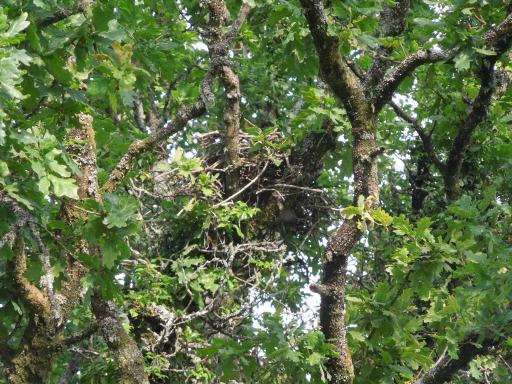
Found under licence: nest containing at least two chicks, nine metres up in a former Carrion Crow nest in an oak in lightly-timbered grassland on very secluded private land at 242 metres asl.  (In the second of my two photos the nest is in the centre and the white downy chicks just visible within.)

The site is within a few kilometres of the location where I found and reported a displaying pair in May of last year, and might be part of the same nesting area. Chronically under-recorded across most of its breeding range, I would expect there to be many pairs of this species nesting across Glamorgan and the wider area.  The legal status of course precludes a close approach to a nest, but breeding Hobbies can be detected for recording and conservation purposes by various methods. These include: watching and listening for their reactions to intruding Buzzards and Red Kites (which are mobbed if they pass close to the nest); following or tracing back the flight paths of birds on hunting forays; and observing the activity of family parties during the post-fledging period in August-September.

Birders often regard mid- to late summer as a dull period due to the general absence of vagrants and scarce migrants, but there are useful finds to be made if the quieter areas of the landscape are sought out and the scarcer breeding species responsibly targeted.
Midsummer flocks and movements

The nesting season is currently at peak, both for the range of species nesting and for many individual taxa (e.g. finches, larks, warblers). Yet a few species have already completed their breeding cycles and are now more widely in evidence. Many Mistle Thrushes are forming post-breeding flocks – I counted 31 in a gathering at one site earlier this week. Most of the Crossbill population nests in late winter, and from late spring onwards many of them move (‘irrupt’) to find new areas with supplies of conifer seeds – they’ve been very evident in recent days, and may be seen or heard calling over any location, with or without suitable trees. Another early nesting species is Goshawk – at the sole (confidential) site where I’ve been able to monitor progress the young have fledged from the nest, with probably three juveniles calling nearby in the woodland.

Hobbies

A pair of Hobbies were displaying at the end of May at a site in the east of the county. For obvious reasons, I won’t specify the location, but the birds are in the former coalfield (far to the N of the M4) at an altitude of between 200 and 300 metres (depending on where they have since settled). The area will be monitored through the balance of the summer, but given that they are established at the location concerned, I would consequently expect them to be fairly widespread through the lower ground in the Vale of Glamorgan to the south, as well as more sparingly into the hills. It’s well worth searching out this species if you enjoy a challenge – they are hard to locate and can remain undetected even in well-watched areas, but experience elsewhere is that even incidental sightings of Hobbies usually denote undiscovered breeding pairs (Schedule 1 restrictions apply). The birds return to the same areas each year, so records from previous years are still worth following up.

Good season for Long-tailed Tits

Despite the necessary restrictions on travel, I was able to keep tabs on the progress of five Long-tailed Tit nests during the spring (all on or adjacent to private land to which I had access). Remarkably, all five appear to have been successful – young hatched in all, when last visited were close to fledging, and all five nests were still intact a few days later (nests attacked by a predator are usually torn to pieces). Normally this species has a very high nest failure rate (around 80-90%), e.g. of 20 nests I monitored in another county last year, at least 15 failed – a dozen of them due to predation. Even though a small sample size from a highly localised area (all the nests were within 2 km), it suggests an outstanding season for the species – an impression reinforced by the family parties in evidence elsewhere (e.g. a flock of 14 at Nelson on Thursday 4/6).