There’s a local field trip to Peterston Moors by the R. Ely, as a follow on from the indoor meeting about the birds of the Ely valley, in particular Green Sandpiper and the ongoing survey.
Meet at 9 a.m. in the small car park opposite the Sportsman’s Rest pub in Peterston-super-Ely village, CF5 6LH. The riverside fields are very muddy and wellies are necessary or at least warterproof footwear of some kind [not just water repellent walking trainers]. We will watch the weather as the river could be quite high if there’s a lot of rain.
Please let me know iof you’re intending to come. John Wilson johndw1948 at gmail dot com
A Grey Wag is still frequenting Sully Brook by the Medieval Village and 20 drake Tufted Ducks were on W lake before the rain stopped any birding. Later after the rain eased there were a few Redwing in E paddock.
We had a successful trip to Parc Cwm Darran today. We even managed to avoid the rain. Perhaps the stand out was a really confiding male Kingfisher, which gave us cracking views. Overhead we saw Red Kite, Buzzard and Sparrowhawk plus a couple of Ravens. Passerines were thin on the ground due to the strong wind. We did catch views of Jay, Mistle Thrush and Redwing though. Redpolls were heard but not seen however. At Rhaslas we saw 2 Great Crested Grebe, c.20 Wigeon, 3 fem Goldeneye and 6 Mute Swans. A distant flying flock of c.200 Golden Plover was also seen. Totla species logged was 41 which was better than expected. Full list can be seen by clicking here.
First walk in the park after returning from a week away in N Wales. Nothing too exciting in the morning rain, but a 2nd yr Med Gull was with Black-headed Gulls on W lake, the first I’ve seen there for a while.
Couple of good birds in the last 3 days, not seen by me I hasten to add, but found by Graham Smith – a Red-rumped Swallow on Weds evening and a Ring Ouzel yesterday, both in the area above Sully Brook. For me today a good number of Fieldfare & Redwing dotted around the place, one feeding bunch disturbed by a Sparrowhawk that shot into their bush and settled for a few seconds. A Cetti’s Warbler was singing v close to me along the Mile Road near the centre viewpoint but would not show. A total of 3 feeding parties of Long-tailed Tits were seen, tho’ nothing too exciting accompanied them, apart from a Goldcrest. A Chiffchaff was calling by the Mile Road yesterday morning.
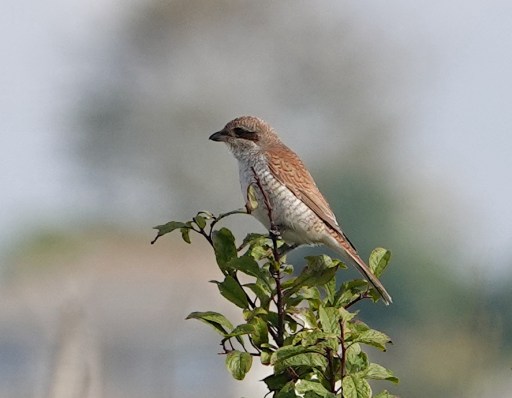
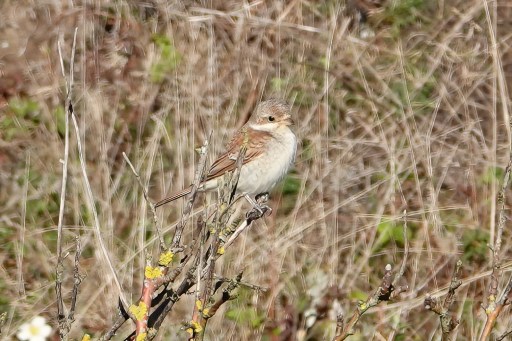
Another cracking trip to Dorset. En route to the Portland Bird Observatory we stopped off at Maiden Castle to try for Corn Bunting. We struggled at first but eventually one popped up on a barbed wire fence. Next stop was RSPB Lodmoor, where we soon found a Spoonbill amongst the Canada Geese. A fly-over Marsh Harrier put a lot of birds up, amongst which were both Little and Great White Egrets. Walking round to the north of the site we were delighted to see plenty of waders, including LittleStint, CurlewSandpiper, Ruff, Black–tailedGodwit, Snipe, CommonSandpiper and Dunlin. John Wilson also glimpsed a GreenSandpiper – a great selection of waders. Several YellowWagtails were present too. The number of MediterraneanGulls there is incredible. We then heard that the Red–backedShrike that had been there for a week was still on the old tip. What a bird! The scalloped juvenile plumage was stunning [see pix below]. Off to Ferrybridge next, where we had misjudged the tide. The water was almost up to the viewing platform, meaning few waders were visible. There were a few Dunlin, a Sanderling and a LittleStint there. In the harbour was a lone Brent Goose. Saturday dawned bright and we spent the first few hours around the Obs. Sea-watching wasn’t easy as the winds were northerly, pushing birds off-shore. An oddity was a Whitethroat that was perched on a rock right next to the obelisk. We saw plenty of Gannets, a few auks, Scoter plus Cormorant and Shag. A RockPipit was seen in this area too. After lunch we walked to Culverwell and up to the top fields. There were plenty of hirundines passing through with some other passerine movement. The Wheatears in the fields were great to see. Kestrels seemed to be everywhere. Some of the group also got on to a Merlin and a LesserRedpoll was heard calling as it flew overhead. Following a visit to Radipole, where we saw a Hobby and a Kingfisher, we then decided to re- visit Ferrybridge for a second chance of watching waders on a rising tide. We weren’t able to add many new species but there were greater numbers of waders present, including several RingedPlovers and Turnstones. An immature CommonGull caused some discussion. We were up early on the Sunday and were delighted to see the LittleOwl in the Obs Quarry. Martin Rich also saw a BarnOwl go in to roost in the quarry. There were several passerines in the quarry with at least four SpottedFlycatchers and a Blackcap seen. Back in the Obs building, there was a quick shout and we were delighted to get on to a TurtleDove on the wire. More sea-watching brought some decent but distant views of BalearicShearwaters and there was a light passage of Kittiwakes. We were privileged to see a Firecrest in the hand at Culverwell. The ringer had also caught a SpottedFlycatcher but had released it prior to our arrival. He told us that a Wryneck had been seen in a nearby quarry. We scoured the area but had no success unfortunately. We decided to re-visit Lodmoor on the way home, where both WaterRail and BeardedTit were new for the trip. Cetti’s Warblers were loudly calling from waterside bushes and there were also several Chiffchaffs present. Some of us went for a second viewing of the Red–backedShrike. Not a bad way to finish off a great weekend’s birding. Once again thanks to John Wilson for organising the trip and to the fellow GBC members who made it a great experience.
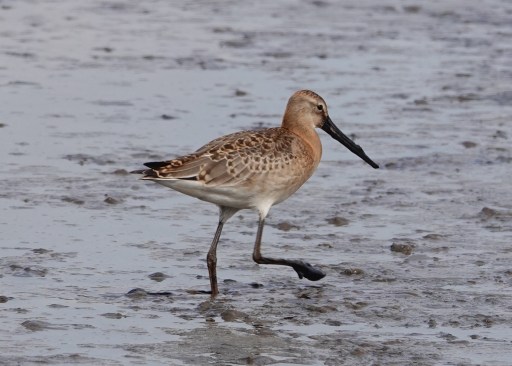
There were only seven participants- perhaps some were put off by the poor weather forecast. We had prepared a contingency plan of dashing to Penclacwydd WWT in the event of heavy rain. We needn’t have worried however as the weather was glorious. We met in the car park at Pembrey Old Harbour and ambled up to the old dock wall. The tide was on the turn, so we hoping that the terns present would be pushed up towards us. As it happens the tide was fairly low, meaning telescopes were the order of the day. Scanning the tide line we saw hundreds of Sandwich Terns fishing off-shore. Amongst them were several smaller terns. After a bit of searching we picked out Little, Common and Arctic Terns amongst them. A quick shout got us all on to a juv Black Tern that had landed in the tern flock. It was surprising how much smaller it was than the other terns. There was a smart Bar-tailed Godwit, loafing amongst the Oystercatchers. Other waders there included Ringed Plover, Sanderling and Dunlin. (A Curlew Sandpiper was reported after we had moved on to Kidwelly). Several Mediterranean Gulls and a couple of Gannets were also seen. On the mud by the railway bridge at Kidwelly Quay we saw several Greenshank, Redshank, Dunlin plus a couple of Common Sandpipers. Also present were two Whimbrel, fifteen Curlew, a Kingfisher and a very fleeting Wood Sandpiper. Elsewhere we saw several Little Egrets, a Red Kite, two Buzzards, Swallows, Stonechats and good numbers of gulls. A very sharp shower brought a close to a very successful trip.
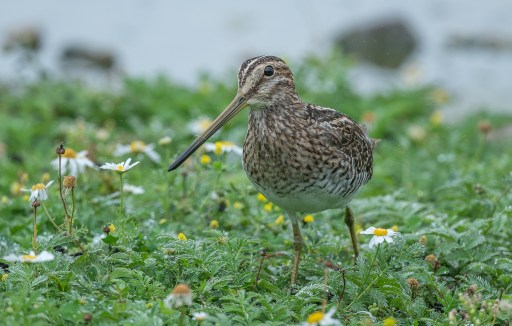
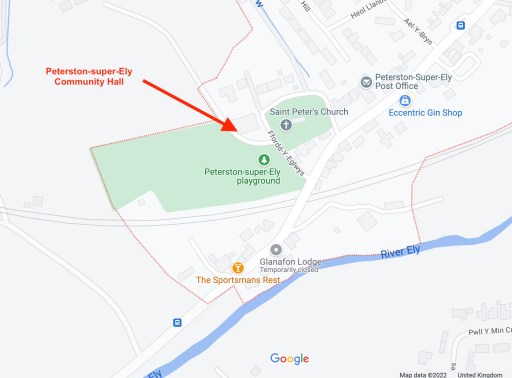
Our next indoor meeting will be on Tuesday, November 1st in Peterston-super-Ely Community Hall at 7 p.m. The topic will be ‘The Birds of the Ely Valley’ and will include an update on our on-going Green Sandpiper survey. The talk will feature many of Tim Collier’s excellent photos, all taken in the valley (e.g. the Common Snipe below courtesy Tim Collier).
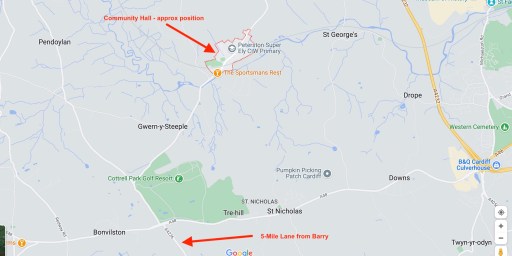
In Peterston-super-Ely village enter Ffordd-yr-Eglwys and take the first left and the hall is on the right. There’s a couple of maps below showing the overall routes and the village itself with the hall location. Click each image for a larger one.
An ‘official’ GBC field trip with 13 participants. We walked out to Sker Pt then along the Haul Road to the rivermouth. Highlights were reasonable if distant [for photography] views of the smart Red-backed Shrike that was near the ‘surfers path’ out towards Sker. At Sker Pt were c.200 Golden Plover with a single Grey Plover in with them. 6 Chough were ferretting through livestock poop E of Sker Pt, finding plenty of bugs to eat. At Sker Pt there were also a few Oystercatdher and Turnstone and plenty of Curlew. Out by the rivermouth was dead [3 noisy offroad bikers present]. On the way back we had an unexpected Red-throated Diver just offshore by Kenfig Sands. Just 31 species seen – click here for the list.
There have been large movements of winter thrushes in the last two days. Yesterday I saw several flocks of up to 100 birds, a mixture of mainly Redwing and Fieldfare mixed in with them. Today a couple more flocks of nearly all Fieldfare, sizing around 80 birds in each. Also a Red Kite drifted over west paddock heading north, mobbed by Crows.
At Porth Teigr on Sun there was a fem type Redstart in conifers outside the BBC studios – not conclusive as to whether it was a Common or a Black Redstart, the latter of which had been reported a few days before. Too brief and quick for a photo. There were 3 Meadow Pipits on the rough ground there and a few Goldfinches.
At Cosmeston today there were 2 Stonechats in the Snipe paddock, and a single Swallow flew over. Two days ago there were 4 Little Grebes in W lake bay and several Swallows flew through.
Rather shorter notice than usual for which I apologise.
We have a local field trip to Sker and Kenfig river mouth on Tues next week, 18th Oct. We will meet outside the Kenfig reserve centre building at 09:30, then walk slowly out to Sker Point, maybe after a quick look at the pool. High tide is not until 12:30. The plan is then to walk along the Haul Road as far as the rivermouth to the west, on the border with Neath PT. Hopefully there’ll be something of interest on the beach or in the saltmarsh. The walk to the rivermouth is flat and takes about 45 mins to an hour each way, depending on how often we stop.
As always please let me know if you intend coming along.
Just a reminder that the first deadline for submitting applications for this scheme exires on 30th Oct. The next deadline is 28th Feb 2023. Full details cn be found here.
A Grey Wagtail was in Sully Brook by the Medieval Village. E lake had 8 Tufted Ducks and a Heron was resting in a tree by W lake bay. A fem Sparrowhawk flew over W paddock and a Chiffchaff was with some Long-tailed Tits in the car park.
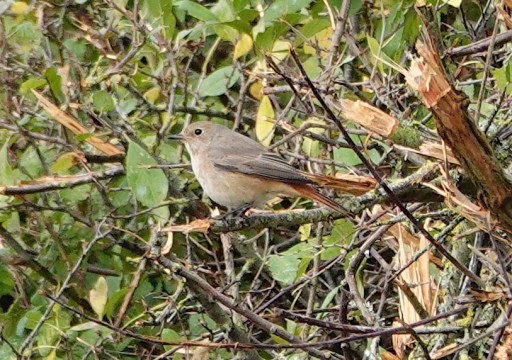
Pretty quiet at Lavernock this morning during a gentle post-Covid walk [managed to avoid it for 2 1/2 yrs!], but this imm Redstart was nice to watch foraging from the hedge by the coast path.
Highlights: An Ortolan Bunting turned up a Lavernock (19th – 20th ), a site with a notable historic track record for the species. Yellow-browed Warblers were found at Kenfig (28th ) and Dunraven (29th ). A Cattle Egret arrived at Llanishen Reservoir (5th ). Three Whooper Swans coasted south east past Dunraven (29th ), while the long-stayer remained at Cardiff Bay. Other Sites: Great White Egrets were recorded at Kenfig Pool (5th ), Llanishen Reservoir (two on 25th ), Ogmore Estuary (two on 26th ) and Sker (30th ). A Bittern was seen at Kenfig Pool. Ten Little Egrets at Ogmore Estuary was a site high count. Raptors included a Hen Harrier at Cwm Cadlan, Marsh Harriers at Kenfig and Lavernock, Merlins at Kenfig and Dunraven, with Hobbies at Sker and Ogmore Estuary. Waders of note comprised Curlew Sandpiper and Little Stint from Kenfig, plus Little Ringed Plover and Ruff at Ogmore Estuary. Two Black Terns and an Arctic Tern graced Parc Tredelerch. Passage Ring Ouzels called in at Craig y Llyn, Rhigos (three) and Craig y Bwlch, Hirwaun. West Aberthaw held a Firecrest. Summary by Paul Roberts
All species, apart from Jackdaw, are being trapped and marked within the East Glamorgan recording area, and of course, any could be seen in either the east or west of VC41. Gower in this case, is used simply to refer to the group under which the rings are registered rather than a geographical area for the project.
Colour-marked Bird Reporter
Gower Ringing Group operates several colour-ringing projects trying to better understand the movements and demographics of our study species:
Dipper
Jackdaw
Rock Pipit
Willow Tit
The Group is keen to collect sightings of these birds, and welcomes submissions from all recorders. As a result, a new colour-marked bird reporter is available to capture any resightings, https://gower-ringing-group.shinyapps.io/sightings/.
We were due to start our winter talks programme next week. Unfortunately Peter Sampson from the Flatholm Society, who was due to give us a talk about this fascinating island, is unwell. Given such short notice, we have been unable to arrange an alternative. Sorry folks.
Our next talk will be on Tuesday November 1st on the ‘Birds of the Ely Valley’. Details on venue etc will be posted closer to the event.
I’ve finally recovered from the annual Club weekend at Portland Bird Observatory on Portland Bill in Dorset. 12 members enjoyed a productive weekend with some excitng birds. Top of the bill for most was probably the immature Red-backed Shrike at Lodmoor, this location also giving us Little Stint, Curlew Sandpiper, Ruff, Spoonbill and some saw Bearded Tit. The Bill itself produced inter alia, passing Balearic Shearwaters, a Firecrest in the hand and a Turtle Dove!. Also we stopped off at Maiden Castle by Dorchester on the way down and eventually got on to a Corn Bunting. Altogether 104 species were logged. Here’s the full list: https://drive.google.com/…/18K7n4Ne8UE3pAvUT4DV…/view…
A big thanks to all who came, and of course to Martin, Pete “The Prof” Morgan and all others at the Obs.
We’re pleased to announce that we have put together a small grants scheme, which offers the possibility for GBC members and indeed non-members to apply for a grant of up to £250, which must be used for a project directly or indirectly benefitting any birds which are Species of Conservation Concern in Wales. Full details and a downloadable information sheet and application form can be seen on this new page on the website.






 Glamorgan Bird Club
You must be logged in to post a comment.